CAS: 7738-94-5; Chromic Acid
该化合物是一种强大的氧化剂和强酸,主要用于各种工业用途,包括金属加工,电镀和有机合成中的试剂,通常被作为一种深红到褐色溶液,具有高度腐蚀性和毒性.铬酸以其氧化有机化合物的能力而著称,并经常用于制备铬盐.化合物在水中溶解,形成一种高酸溶液,可释放有毒铬离子,对健康和环境构成重大风险.由于其致癌性质,对其使用和处置实行严格监管.安全防范,包括使用个人防护设备和适当的通风,在处理铬酸时至关重要.其化学行为受到pH和其他物质的存在影响,使其在化学过程中成为多用途但危险的试剂.
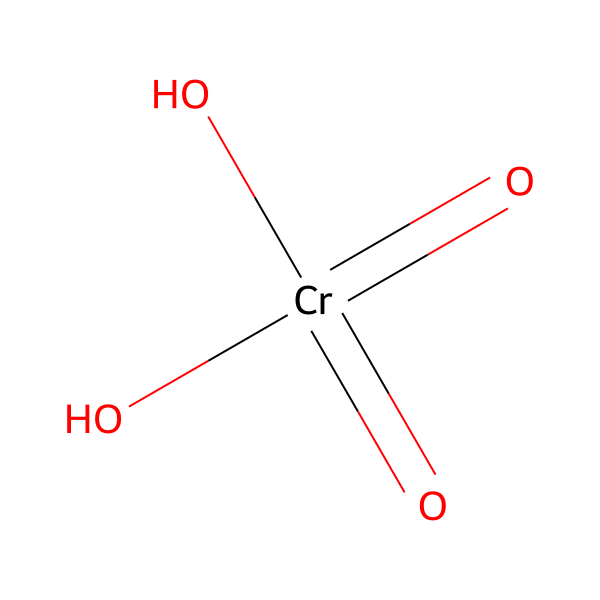
- 相似结构搜索
- 产品信息参考

- InChIKey: KRVSOGSZCMJSLX-UHFFFAOYSA-L
- InChI=1S/Cr.2H2O.2O/h;2*1H2;;/q+2;;;;/p-2…
- 计算化学: 氢键受体数*氢键供体数*可旋转键数*
物理性质
MSDS等安全信息
- GHS象形图


- GHS符号GHS03 & GHS08 & GHS06 & GHS05 & GHS09;
注释: Flame over circle & Health hazard & Skull and crossbones & Corrosion & Environment - 危险类别Ox. Liq. 1
致癌性 类别1B
Muta. 1B
生殖毒性 类别2
急性毒性 类别2(吸入)
急性毒性 类别2(经皮)
急性毒性 类别3(经口)
特定目标器官毒性 - 单次接触 类别3
特定目标器官毒性-重复接触 类别1
皮肤腐蚀 类别1A
严重眼损伤 类别1
呼吸道致敏 类别1
皮肤致敏 类别1
水生急性毒性 类别1
水生慢性毒性 类别1
致突变性 类别2
急性毒性 类别1(吸入)
急性毒性 类别2(经口)
皮肤腐蚀 类别1B
Ox. Sol. 1
致癌性 类别1A
急性毒性 类别3(经皮)
Muta. 1A
Ox. Liq. 3
急性毒性 类别1(经皮) - 警示词Danger(危险)
- 危险描述H271 |可能引起火灾或爆炸;强氧化剂.
H350i |May cause cancer by inhalation.
H340 |可能导致遗传缺陷.
H361f |怀疑会影响生育能力.
H330 |吸入致命.
H310 |皮肤接触致命.
H301 |吞咽会中毒.
H335 |可能引起呼吸道刺激.
H372 |长期或反复接触损害器官.
H314 |造成严重皮肤灼伤和眼损伤.
H318 |造成严重眼损伤.
H334 |吸入可能引起过敏或哮喘症状或呼吸困难.
H317 |可能引起皮肤过敏反应.
H400 |对水生生物毒性极大.
H410 |对水生生物毒性极大并具有长期持续影响.
H350 |可能致癌.
H341 |怀疑导致遗传缺陷.
H361 |怀疑对生育能力或胎儿造成损害.
H300 |吞咽致命.
H311 |皮肤接触会中毒.
H272 |可能加剧火灾;氧化剂. - 防范说明P261-P272-P280-P302+P352-P333+P313-P321-P363-P501-P273-P391-P501-P273-P391-P501
- UN编号1755.0
- 安全声明IDENTIFICATION AND USE: Chromic acid forms dark purplish-red crystals. It is used as photographic chemical; aluminum anodizing reagent; chrome electroplating/zinc colorless conversion coatings reagent; side-chain oxidation reagent, and wood preservative. HUMAN EXPOSURE AND TOXICITY: Repeated or prolonged exposure to chromic acid or chromate dust or mist may cause an ulceration and perforation of the nasal septum. Respiratory irritation may occur with symptoms resembling asthma. Liver damage with yellow jaundice has been reported. Prolonged or repeated exposure of the skin may cause a skin rash. Allergic skin rash may also occur. Contact causes severe eye injury characterized by infiltration, vascularization, and opacification of the cornea. Full-thickness skin burns covering as little as 1% of the body surface area may lead to irreversible acute tubular necrosis secondary to acute chromium intoxication. The mortality rate is high if the burned area exceeds approximately 10% of the body surface. The correlation with duration of chrome bath work associated with exposure to chromium acid was positive only for cancers of the lung and bronchus in male workers. It was experimentally and epidemiologically confirmed that hexavalent chromium compounds act as carcinogens and cause specific biological effects on the respiratory system. These characteristics of hexavalent compounds might be attributable to the strong oxidizing potency and/or high permeability through the cell membrane. Furthermore, hexavalent compounds might be entirely different in biological action from trivalent compounds which are chemically most stable. ANIMAL STUDIES: There is limited evidence in experimental animals for the carcinogenicity of chromic acid. There was an increased incidence in abnormalities (cleft palate, cleft sternum, perforated sternum) in developmental studies in mice. In CHO cells, there was a significant increase in SCE with CrVI compounds. In the Ames test there was a dose-response for increase in revertant colonies for all CrVI compounds at 10-200 ug/plate with TA1537, TA98 and TA100. Addition of S9 did not affect mutation incidence. In other studies, when tested in Salmonella typhimurium strains TA1537, TA1538, TA98 and TA100 the S9 mix decreased the mutagenicity of CrVI compounds. | Chromic acid is highly corrosive and strongly oxidative. Many strong acids cause tissue burns through the denaturation of proteins and partial hydrolysis of proteins. Most proteins denature at pH values of less than 3-4. The large-scale denaturation of proteins, de-esterification of lipids and subsequent desiccation of tissues leads to chemical burns. . Symptoms include itching, bleaching or darkening of skin or tissues, blistering and burning sensations. Chromic acid also denatures proteins through inserting oxygen atoms into protein side chains. Chromic acid is also a source of chromium and especially hexavalent chromium. Hexavalent chromium compounds (including chromium trioxide, chromic acids, chromates, chlorochromates) are toxic and carcinogenic. For this reason, chromic acid oxidation is not used on an industrial scale except in the aerospace industry. Hexavalent chromium's carcinogenic effects are caused by its metabolites, pentavalent and trivalent chromium. The DNA damage may be caused by hydroxyl radicals produced during reoxidation of pentavalent chromium by hydrogen peroxide molecules present in the cell. Trivalent chromium may also form complexes with peptides, proteins, and DNA, resulting in DNA-protein crosslinks, DNA strand breaks, DNA-DNA interstrand crosslinks, chromium-DNA adducts, chromosomal aberrations and alterations in cellular signaling pathways. It has been shown to induce carcinogenesis by overstimulating cellular regulatory pathways and increasing peroxide levels by activating certain mitogen-activated protein kinases. It can also cause transcriptional repression by cross-linking histone deacetylase 1-DNA methyltransferase 1 complexes to CYP1A1 promoter chromatin, inhibiting histone modification. Chromium may increase its own toxicity by modifying metal regulatory transcription factor 1, causing the inhibition of zinc-induced metallothionein transcription. (A12, L16, A34, A35, A36)
- 危险类别码Classified as a water-soluble, hexavalent chromium compound; [ACGIH] Chronic exposure to hexavalent chromium may produce evidence of kidney and liver injury. [ATSDR Case Studies # 4] Can cause second and third degree burns on short contact; [CHRIS] Highly corrosive to skin; [Quick CPC] Occupational asthma documented in a cement floor worker, plater, and other workers exposed to chromate salt; [Malo] Epidemiological studies of chromate production workers showed increased lung cancer. [IARC] See Chromium and linked occupational diseases.
欧盟法规
ECHA物质ECHA物质欧盟授权物质清单C&L通报REACH预注册欧盟候选物质清单上下游产品
sulfuric acid water chromium(VI) oxide dichromic acidchromium bromine chromate(VI) ion ozone合成工艺路线路线简述
专利信息
专利号:US-4288608-A
优先权日:1978-06-01
标题:Synthesis of anthracyclines
发明人:JOHNSON FRANCIS; KIM KYOUNG S
权利人:RESEARCH CORP
摘要:There is provided a novel method of synthesizing certain heterocyclic quinones. In particular there is provided a novel and regiospecific synthesis of 9-acetyl-6,11-dihydroxy-4-methoxy-7,8,9,10-tetrahydronaphthacene-5,12-quinone (7,9-dideoxydaunomycinone) which is known intermediate in the synthesis of daunomycinone. There is also provided a method of preparing analogs of 7,9-dideoxydaunomycinone which thus provide for the preparation of known and desired analogs of daunomycinone. Daunomycinone is a known compound which is an intermediate in the preparation of the clinically accepted naturally-occurring antitumor antibiotics daunomycin and its derivitive adriamycin.
专利号:US-5451691-A
优先权日:1992-05-07
标题 :Synthesis of cosmetic ingredients
发明人:CRAWFORD DUNCAN J; RAWLINGS ANTHONY V; SCOTT IAN R
权利人:ARDEN ELIZABETH CO
摘要:A method of synthesis of ω-hydroxy fatty acid containing ceramides having the general structure (1). ##STR1## where A represents CH 2 or --CHâ•?CH--Y represents a residue of a C 14 to C 22 fatty acid having the structure (2) ##STR2## where Z is --OH or an epoxy oxygen n x is an integer of from 12 to 20 n y is an integer of from 20 to 40 n z is 0 or an integer of from 1 to 4 n a is an integer of from 8 to 50 n b is an integer of from 10 to 100 n and n is an integer of from 7 to 27.
专利号:US-3962291-A
优先权日:1974-09-05
标 题:Total synthesis of 11-alkyl steroids
发明人:GARLAND ROBERT B; PAPPO RAPHAEL
权利人:SEARLE & CO
摘要:A novel total synthesis of 11-alkyl steroids, utilizing readily available and inexpensive raw materials, is described. The resulting products are useful and novel pharmacological agents possessing, for example, selective hormonal properties.
专利号:EP-0034338-B1
优先权日:1980-02-14
标题:Catalyst for the synthesis of alcohol mixtures containing methanol and higher alcohols
摘要:1. Catalyst for the synthesis of alcohol mixtures containing methanol and higer alcohols one the basis of starting catalysts containing copper oxide, zinc oxide and, optionally, aluminium oxide, obtainable either by (a) producing from soluble salts of copper, zinc and, optionally, aluminium (principal constituents) by joint precipitation with promoter compounds in an alkaline medium a precipitate which is calcined after removal of the impurity ions ; or by (b) impregnating a mixture of the oxides of copper, zinc, and, optionally, aluminium, with solutions of the promoter compounds and calcining the resultant product ; wherein the promoter compounds represent compounds of chromium, cerium, lanthanum, manganese, thorium or of combinations of these elements, and wherein at any desired stage of production alkali compounds are added.
专利号:US-4489206-A
优先权日:1983-05-13
标 题:Synthesis of (+)-4-demethoxydaunomycinone
发明人:CAVA MICHAEL P; DOMINGUEZ DOMINGO
权利人:ADRIA LAB INC
摘要:It has been found that stereospecific R(-)-4-demethoxy-7-deoxydaunomycinone can be synthesized from the known compound 4-demethoxy-7,9-dideoxydaunomycinone. R(-)-4-Demethoxy-7-deoxy-daunomycinone is an intermediate in the synthesis of (+)-4-demethoxydaunomycinone, the aglycone of the nonnaturally occurring and antitumor active (-)7(S)9(S)-4-demethoxydaunorubicin.
专利号:US-5384335-A
优先权日:1991-03-26
标 题:Methanol synthesis using a catalyst combination of alkali or alkaline earth salts and reduced copper chromite
发明人:TIERNEY JOHN W; WENDER IRVING; PALEKAR VISHWESH M
权利人:UNIV PITTSBURGH
摘要:The present invention relates to a novel route for the synthesis of methanol, and more specifically to the production of methanol by contacting synthesis gas under relatively mild conditions in a slurry phase with a catalyst combination comprising reduced copper chromite and basic alkali salts or alkaline earth salts. The present invention allows the synthesis of methanol to occur in the temperature range of approximately 100°-160° C. and the pressure range of 40-65 atm. The process produces methanol with up to 90% syngas conversion per pass and up to 95% methanol selectivity. The only major by-product is a small amount of easily separated methyl formate. Very small amounts of water, carbon dioxide and dimethyl ether are also produced. The present catalyst combination also is capable of tolerating fluctuations in the H 2 /CO ratio without major deleterious effect on the reaction rate. Furthermore, carbon dioxide and water are also tolerated without substantial catalyst deactivation.
网址: http://www.jych.com
企业联系电话:0519-86666676👤
地址:常州市钟楼区西林街道张家村118号1号楼303室
企业联系电话:0519-86666676👤
📞常州市佳业化工有限公司 ⚠️参考联系方式
联系人:巢依桐
电话:0519-86666676
手机:18661144123
传真:0519-86699676
邮箱:1661209034@qq.com
通信地址: 常州市钟楼区西林街道张家村118号1号楼303室
邮编: 213042
电话:0519-86666676
手机:18661144123
传真:0519-86699676
邮箱:1661209034@qq.com
通信地址: 常州市钟楼区西林街道张家村118号1号楼303室
邮编: 213042
🆔 联系时候可告知是从"百琢研"平台获取的信息.
⚠️ 声明: 该企业未认证、未认领,请自行辨别信息的真实性和可靠性。咨询或交易时请注意风险评估与信息核实,百琢研不参与任何交易。企业认领注册入口→
地址:常州市钟楼区西林街道张家村118号1号楼303室
⚠️ 未注册 · 未认证企业
 备注: 📌 数据来源说明:本展台内容基于各搜索引擎等公开数据整理,仅作展示用途。请用户自行辨别
✉️ 若企业需抹除展台内容或有异议, 请通过页面底部联系方式告知我们,我们会尽快处理。
网址: http://www.jjlchem.com
企业联系电话:021-52915085;021-52910829;15021318527👤
地址:上海中山北路2052号13楼
企业联系电话:021-52915085;021-52910829;15021318527👤
📞上海金锦乐实业有限公司 ⚠️参考联系方式
联系人:黄小姐
电话:021-52915085;021-52910829;15021318527
手机:15021318527
传真:021-52917765
邮箱:jjlchem@jjlchem.com
通信地址: 上海中山北路2052号13楼
邮编: 200063
电话:021-52915085;021-52910829;15021318527
手机:15021318527
传真:021-52917765
邮箱:jjlchem@jjlchem.com
通信地址: 上海中山北路2052号13楼
邮编: 200063
🆔 联系时候可告知是从"百琢研"平台获取的信息.
⚠️ 声明: 该企业未认证、未认领,请自行辨别信息的真实性和可靠性。咨询或交易时请注意风险评估与信息核实,百琢研不参与任何交易。企业认领注册入口→
地址:上海中山北路2052号13楼
⚠️ 未注册 · 未认证企业
备注: 📌 数据来源说明:本展台内容基于各搜索引擎等公开数据整理,仅作展示用途。请用户自行辨别✉️ 若企业需抹除展台内容或有异议, 请通过页面底部联系方式告知我们,我们会尽快处理。
第 1 / 1 页
供应商参考报价(招募中)
品牌试剂参考报价(招募中)
📌 第三方产品分析报告
合成参考文献
参考文献:10.1007/bf01898700
摘要:Kuromizu K, Izumiya N. Synthesis of tyrocidine B. Cellular and Molecular Life Sciences. 1970 Jun;26(6):587–8. doi: 10.1007/bf01898700.



📝 需求与反馈
尽可能描述清楚需求与问题信息

